How To Avoid Falling Victim To A ‘Goldilocks Career’
How To Avoid Falling Victim To A ‘Goldilocks Career’
Are you tired of having a career that’s too hot or too cold? Is achieving career stability simply a pie-in-the-sky dream? Invest in yourself to unlock your potential and create a future that is always “just right.”
A Goldilocks economy has the appearance of being “just right.” It represents an economy in a steady state, with robust employment, stock market stability and solid growth. The term gets its name from the popular children’s story “Goldilocks and the Three Bears.” In case you need a refresher, the story stars a young girl who ventures into a bear family’s home and samples their breakfast. Goldilocks describes Papa Bear’s porridge as “too hot” and Mama Bear’s porridge as “too cold.” But Baby Bear’s porridge is “just right.”
It may sound like the Goldilocks economy is ideal. But in my nearly four decades of navigating business, I’ve seen the Goldilocks economy come and go. History shows us it’s natural to experience boom and bust cycles between moments of calm. For recent examples, we only have to turn our attention back to the burst of the dot-com bubble, or the Great Recession, when subprime mortgages sent the economy on a downward spiral.
Similarly, many hard-working Americans fall victim to a Goldilocks Career. Think back to when you started working in corporate America. As a greenhorn, you were “too young” and were forced to suffer from being overworked and underpaid. Fast-forward to today, where you’re getting the runaround because you’re “too old” or overqualified for a position.
Sure, there are points throughout your corporate career where everything is “just right.” But those moments are often few and far between. Another low with stagnant wages and potential layoffs is always right around the corner. Six out of 10 employers say layoffs are likely at their company this year, and more than half of those companies plan to lay off at least 30% of their workforce, according to a study conducted by Resume Builder.

READ THE FULL ARTICLE ON FORBES
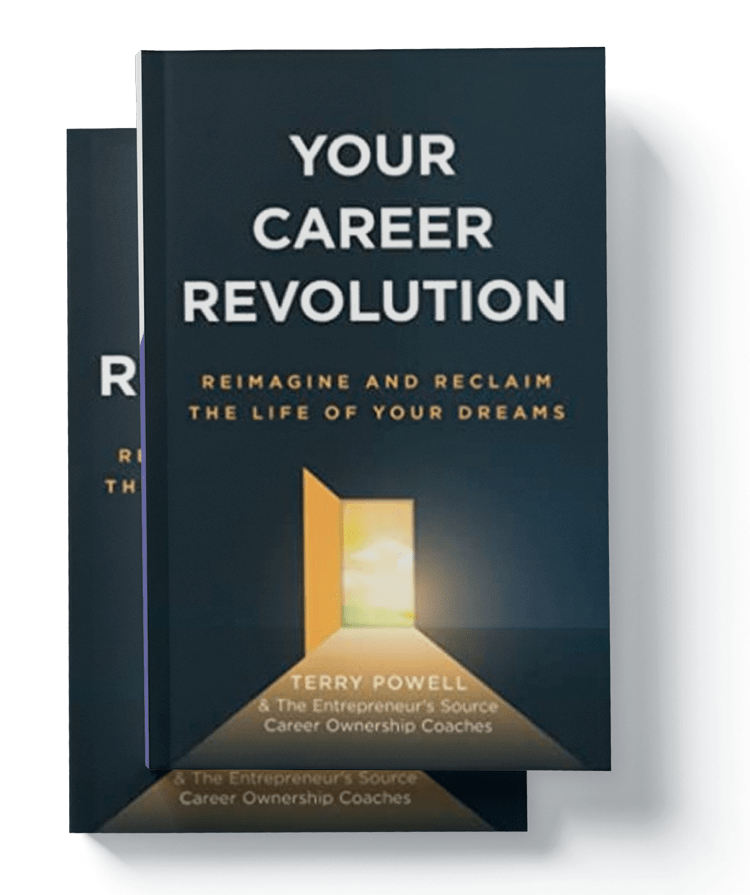 About Your Career Revolution
Our mission is to help individuals explore self-sufficiency as an alternative career.
We help them define their Income, Lifestyle, Wealth, and Equity goals and provide education on the best ways to achieve them. We don’t sell franchises – we help people achieve their dreams of self-sufficiency through business ownership. The approach is different, the experience is different. And it works.
Order on AMAZON
Learn More About Career Coaching
If you are considering a career change, invest in yourself to discover your options, possibilities, and dreams. Chat with one of our coaches to begin your career revolution. To learn more about career coaching, visit www.entrepreneursource.com or check out our guidebook, “Your Career Revolution: Reimagine and Reclaim the Life of Your Dreams.”
Watch Episodes on YouTube or Listen as a Podcast and more!
















Share this post:
Related Posts
Your Trusted Resource for Career Ownership Coaching™ for helpful hints, best practices, anything related to career ownership.

The Unemployment Rate Isn’t Telling the Truth
You have heard the headlines. Unemployment is around 4%. Economists call it "full employment." The job market, we are told, is strong. So why does your job search drag on for months?

After the Layoff
It usually begins the same way. You get a calendar invite with no details. Your manager avoids eye contact on the video call. Then you hear the words that suddenly make your career part of your past.

Rest alone won’t solve burnout if your job is the real issue.
You finally took a break. Maybe it was a long vacation, take some time between jobs, or even a full career pause. You caught up on sleep, unplugged, and started to feel like yourself again. But once you returned to work, the exhaustion crept back in within just a few weeks.