When One Job Becomes Three:
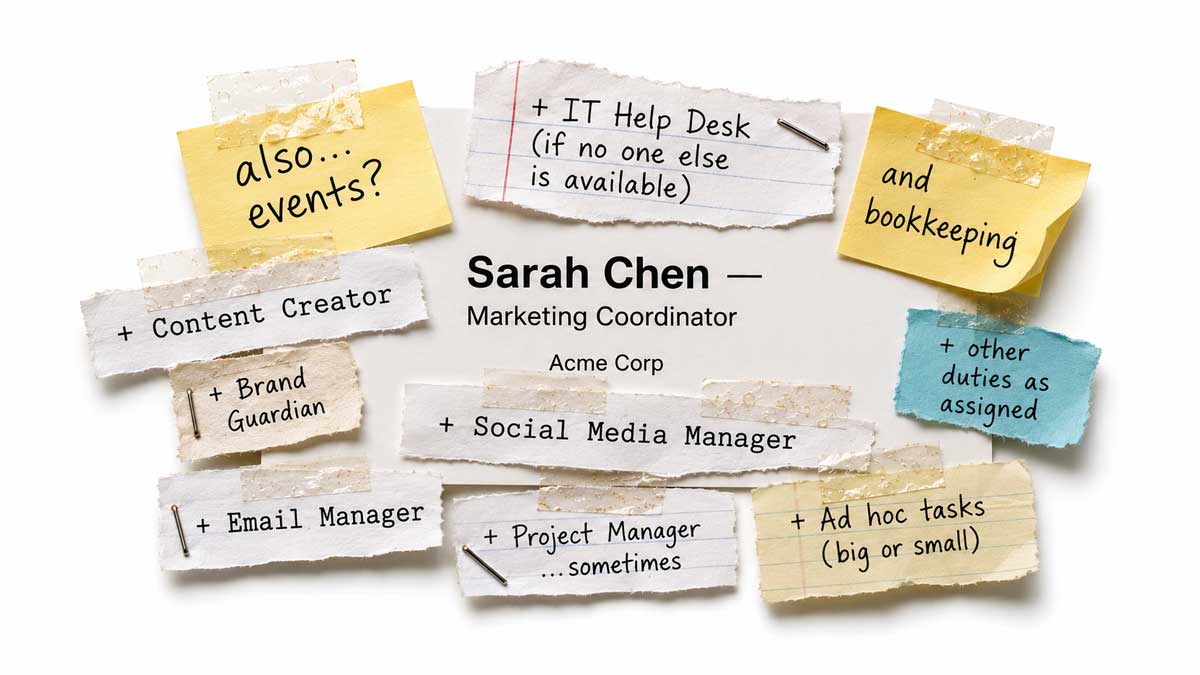
What Ballooning Job Descriptions Are Really Telling You
If a single role now demands 22 responsibilities and 15 qualifications, the problem may not be your resume. It may be the model.
 Somewhere along the way, the job posting stopped being a description and became a wish list. Scroll through any hiring platform today and you will find listings so long they have to be broken into subheads: nine required qualifications, six preferred ones, twenty-two responsibilities. An engineering role asking for eleven duties, eleven skills, and — listed alongside technical requirements — a “positive energetic attitude.”
One communications professional profiled in a recent report described closing a listing mid-scroll because the scope had simply stopped being believable. Her reasoning was blunt: if an employer genuinely thinks one person can do all of that, that tells you something about the employer.
“No one could ever succeed at having 27 priorities.”
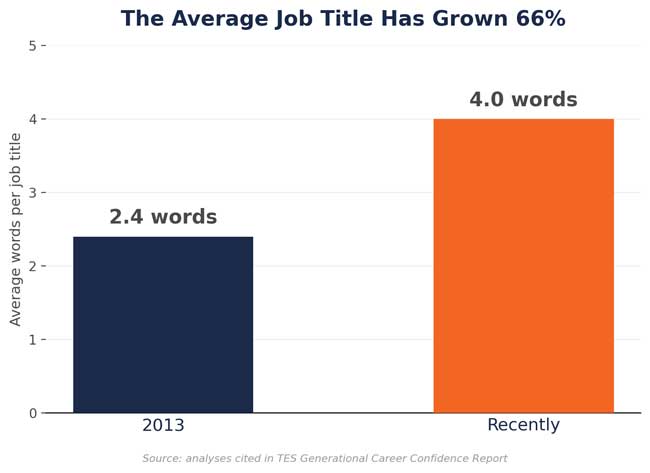
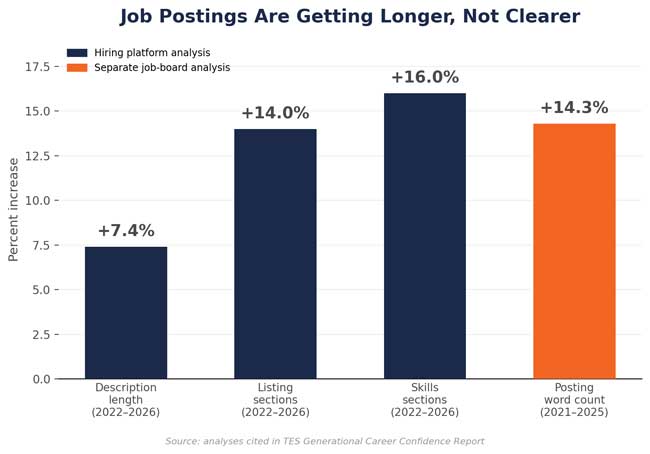 The data points in the same direction. According to analyses cited in that report, the average job title has grown from roughly 2.4 words in 2013 to about four words more recently, driven by increasingly narrow, hyper-specific roles. One hiring platform found job description character counts up 7.4% between 2022 and 2026, with the number of sections in a listing up nearly 14% and skills sections up almost 16% over the same period. A separate job-board analysis found word counts in postings rose 14.3% between 2021 and 2025.
Longer postings are not just an annoyance for applicants. They are a signal about how work is being redistributed — and about who absorbs the overflow.
Two roles, one paycheck
 When a listing merges communications and marketing, or fuses revenue strategy with operations, the consolidation rarely comes with two salaries. It comes with one. The candidate who takes that job inherits a workload built for a team and a title built for a spreadsheet.
That is why so many professionals describe a strange contradiction in their careers: they are working harder than ever and feel less secure than ever. The expanding job description is one of the clearest artifacts of that shift. It asks for more, promises less, and leaves the person in the seat with very little say over how any of it is structured.
What people are actually saying about control
That erosion of control shows up plainly in the research. In the TES Generational Career Confidence Survey, conducted by The Harris Poll among 2,087 U.S. adults, 80% of employees said business ownership gives a person more control over their career than a traditional job — rising to 86% among Millennials.
Related findings from the same survey:
- 83% think business ownership is a viable alternative to a traditional career.
- 70% believe ownership offers more opportunity, stability, and financial growth than a traditional job.
- 66% say ownership offers more job security.
- 49% of employees say workplace ageism keeps them in an unsatisfying job.
- 61% say ownership is the best protection against AI making a career obsolete.
These are reported attitudes, not measured outcomes — people describing how the current model feels from the inside. But the pattern is consistent, and it lines up neatly with what the job listings themselves are showing: roles are widening while the individual’s control over them narrows.
The AI wrinkle
It is worth noting that the sharpest growth in job description length tracks the same window in which generative AI tools became widely available. Employers appear to be writing longer, more granular postings during a period of rapid change in what work looks like. Whether AI is causing that expansion or simply coinciding with it is not something the available data settles — but the effect on applicants is the same either way. The bar keeps moving, and it keeps moving upward.
Meanwhile, 61% of survey respondents said business ownership is the best protection against AI making a career obsolete. Employees are not just noticing the shift. They are already thinking about what sits on the other side of it.
A different question to ask
Most people respond to a bloated job description by asking, “Am I qualified enough?” There is another question worth asking first: “Is this actually the model I want?”
 That is the question Career Ownership Coaching® is built around. A Career Ownership Coach® does not start with listings or resumes. They start with what you want your Income, Lifestyle, Wealth, and Equity™ to look like — and then explore whether the path you are on can realistically deliver it. For some people, the answer is a better job. For others, it is a move from Employment to Empowerment™ through business ownership.
Either way, the decision belongs to you rather than to a posting that keeps growing.
If job descriptions have started to feel like they are describing three roles instead of one, that is worth exploring. A conversation with a Career Ownership Coach® is a no-cost, no-obligation way to find out what your options actually are.
Sources & Notes
Verified primary source (TES): The Entrepreneur’s Source Generational Career Confidence Survey, conducted by The Harris Poll. National online survey of 2,087 U.S. adults, October 8–10, 2025. All survey figures cited above are reported attitudes and are framed as such (“said,” “believe,” “think”) — not measured outcomes.
Article-attributed, not independently verified: All job-posting length statistics (2.4 words to four words in job titles, 2013–recent; 7.4% character-count increase 2022–2026; ~14% growth in listing sections; ~16% growth in skills sections; 14.3% word-count growth 2021–2025) come from the uploaded source article, which attributes them to BambooHR, Greenhouse, and Indeed respectively. These figures have not been traced to the original published analyses. Confirm against primary sources before publication.
Quotation: The pull quote (“No one could ever succeed at having 27 priorities”) is attributed in the source article to a job seeker identified as Robin Olsen. Her name has been omitted from this draft since TES has no direct permission or verification. Verify the quote and secure attribution rights before publication, or replace with a paraphrase.
Open editorial items: (1) The source article does not name its publisher in the uploaded excerpt — confirm the original outlet and date before citing or linking. (2) The AI-timing observation is framed as coincidence, not causation, since no causal evidence exists in the source. (3) Consider whether to link the survey landing page in the closing CTA.
Brand compliance: No use of “franchise” or “franchising.” Marks applied: Career Ownership Coach®, Career Ownership Coaching®, Employment to Empowerment™, Income, Lifestyle, Wealth, and Equity™. The FranchiseInsights.com success-rate statistic was not used.
Watch Episodes on YouTube or Listen as a Podcast and more!















Share this post:
Related Posts
Your Trusted Resource for Career Ownership Coaching™ for helpful hints, best practices, anything related to career ownership.
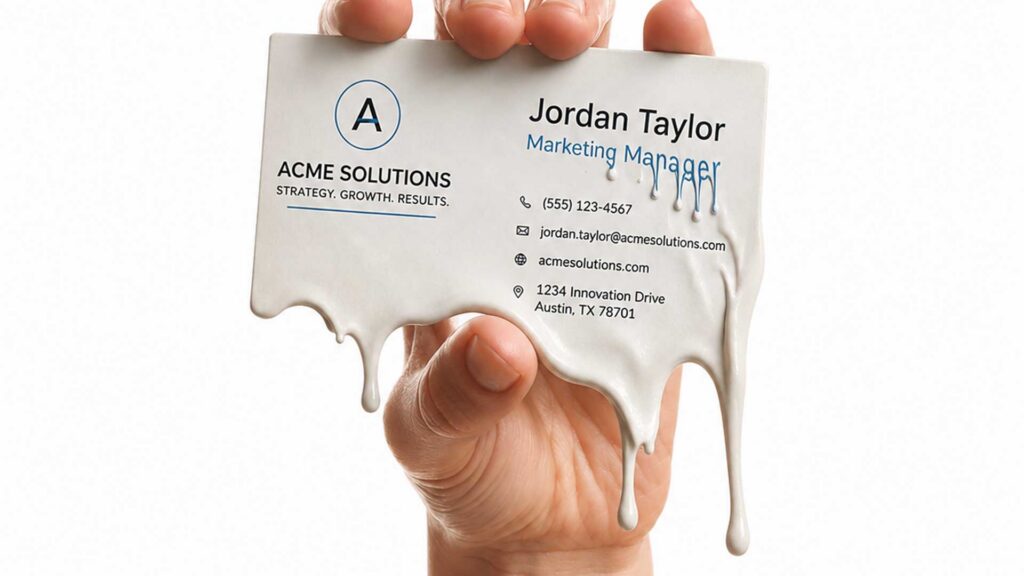
Your Job Title Is Melting.
Are You Ready to Own What Comes Next? The way job titles are changing in the age of AI shows us where true career security really comes from. A big shift is happening in how work itself is organized — and it reaches far beyond any single company or industry. According to the World Economic…

What You Want to Hear vs. What You Need to Hear
AI is now a common place to get advice However, looking at how chatbots are made shows why having a human coach is still important when you face big decisions. These days, most people turn to a machine first when they have a question. AI chatbots have quickly become part of daily life. According to…

What Polymarket’s Boom Reveals About Betting on Yourself
Prediction markets are booming. The data on who actually wins offers a useful lesson for anyone thinking about a different kind of bet: betting on themselves. Prediction markets have gone mainstream. On platforms like Polymarket, millions of people are now putting their money where their mouth is by buying contracts that pay out if an…