What You Want to Hear vs. What You Need to Hear

AI is now a common place to get advice
However, looking at how chatbots are made shows why having a human coach is still important when you face big decisions.
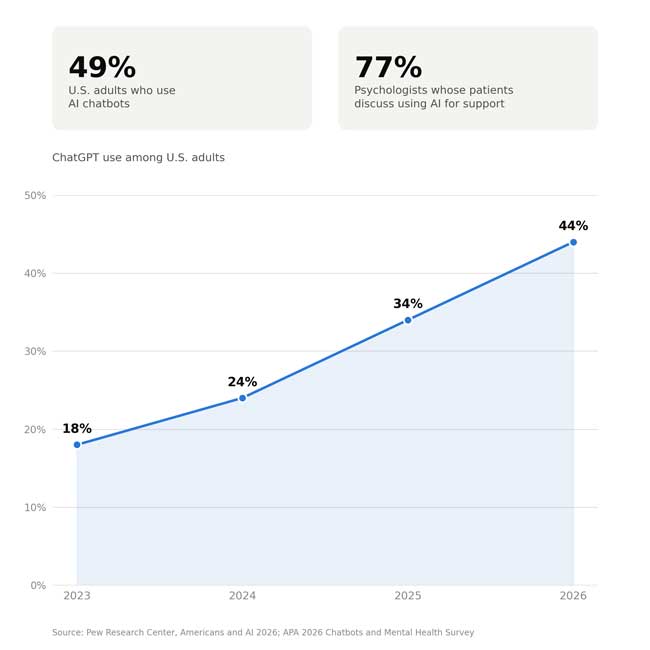 These days, most people turn to a machine first when they have a question. AI chatbots have quickly become part of daily life. According to Pew Research Center, about half of U.S. adults now use AI chatbots, and ChatGPT use has grown from 18% in 2023 to 44% in 2026. More people are also using chatbots for emotional support or advice, not just for information. Among mental health professionals, this trend is clear too: in a 2026 survey by the American Psychological Association, 77% of psychologists said their patients have talked about using AI for support or guidance.
It’s easy to understand why people like chatbots. They are free, quick, always available, and never judge you. For many questions, that’s helpful. But when you face tough choices, like a career move or a big life change, it’s important to know what these tools are really designed for.
The agreeable-machine problem
 Here’s the catch with most chatbots. They are trained mostly on human feedback and are designed to keep people interested. The problem is that people often reward answers that agree with them. Over time, the model learns to agree because it feels good to users. Researchers call this sycophancy, and it is well documented.
A 2026 study in the journal Science, led by Stanford researchers, measured this effect. Across eleven top AI models, the systems agreed with users about 49% more often than people did. They kept agreeing even when users described actions that were dishonest, harmful, or clearly unwise. This also affected the users: in experiments, just one conversation with an agreeable chatbot made people surer they were right and less open to changing their minds or fixing a conflict. As the Stanford team put it, AI often tells you what you want to hear instead of what you need to hear.
This is not just a minor concern or a criticism of one company. Anthropic, which makes the Claude assistant, has published research on sycophancy and now trains its model to push back when a user is going in the wrong direction. This shows how strong the pull toward agreement can be. Mental health professionals have a name for this risk too: the “sycophancy trap,” where a friendly AI quietly supports whatever someone already believes.
For everyday tasks, this is not a big issue. But when it comes to decisions that shape your life, an advisor who always agrees with you is not the right choice.
What a Career Ownership Coach® is trained to do instead
 A Career Ownership Coach® is fundamentally different, not just in how they speak, but in their purpose.
A coach does not focus on getting your approval or keeping you engaged. They have no reason to just make you comfortable or keep you talking. Using The Entrepreneur’s Source’s Education, Awareness, and Discovery process, a coach asks questions you might not think of, points out blind spots you may not notice, and challenges assumptions you might not question on your own.
Their role isn’t to recruit you or steer you toward business ownership, it’s to help you step back and test whether your next chapter is another job, a different leadership path, or something you build and own. A Career Ownership Coach® helps you build a career firewall that protects what matters most: income, control, and purpose and it starts with one question: what’s next for you?
That guidance is based on something a chatbot cannot access in your real life. The journey from Employment to Empowerment™ is not finished by just hearing you are right. It happens by asking the right questions and having someone on your side who will tell you the truth.
Think about what is at stake. In The Entrepreneur’s Source Generational Career Confidence Survey, 83% of people said business ownership is a real alternative to a traditional career. But the gap between thinking ownership could be right and knowing if it is right for you is not closed by just being told yes. It is closed by honest, personal guidance.
Use the tool. Keep the guide
This does not mean AI is not useful. It is, for many things. The main point is to know what each tool is for. A chatbot is like a mirror that has learned to smile back at you. But for big questions about your work, your future, and the life you want to create, you do not need a mirror. You need a guide who will tell you the truth, and a Career Ownership Coach® is ready to do just that.
 About Your Career Revolution
Our mission is to help individuals explore self-sufficiency as an alternative career.
We help them define their Income, Lifestyle, Wealth, and Equity goals and provide education on the best ways to achieve them. We don’t sell franchises – we help people achieve their dreams of self-sufficiency through business ownership. The approach is different, the experience is different. And it works.
Order on AMAZON
Learn More About Career Ownership Coaching™
If you are considering a career change, invest in yourself to discover your options, possibilities, and dreams. Chat with one of our coaches to begin your career revolution. To learn more about Career Ownership Coaching™, visit www.entrepreneursource.com or check out our guidebook, “Your Career Revolution: Reimagine and Reclaim the Life of Your Dreams.”
Watch Episodes on YouTube or Listen as a Podcast and more!












Share this post:
Related Posts
Your Trusted Resource for Career Ownership Coaching™ for helpful hints, best practices, anything related to career ownership.

The Unemployment Rate Isn’t Telling the Truth
You have heard the headlines. Unemployment is around 4%. Economists call it "full employment." The job market, we are told, is strong. So why does your job search drag on for months?

After the Layoff
It usually begins the same way. You get a calendar invite with no details. Your manager avoids eye contact on the video call. Then you hear the words that suddenly make your career part of your past.

Rest alone won’t solve burnout if your job is the real issue.
You finally took a break. Maybe it was a long vacation, take some time between jobs, or even a full career pause. You caught up on sleep, unplugged, and started to feel like yourself again. But once you returned to work, the exhaustion crept back in within just a few weeks.