
The Six-Month Wall

What if the hardest part of losing your job at 55 isn’t the layoff itself, but week 27?
Every job search has a turning point. It’s not about salary or job title, but a date on the calendar. Once you pass it, finding work often becomes much harder than you expected.
Economists in the United States and Canada set that turning point at 27 weeks, just over six months. After that, you’re considered long-term unemployed. This article looks at why this happens, who it affects most in both countries, and what you can do to avoid reaching that point.
How Many People Are Behind the Wall
In the U.S., about 2 million people had been out of work for 27 weeks or more in October 2026, according to the Bureau of Labor Statistics. That’s 27.6% of everyone looking for work. More than one in four job seekers had been searching for over six months.
In Canada, the picture is similar. Statistics Canada reports that 23.7% of unemployed Canadians were long-term unemployed in October 2026. That’s up from 21.5% a year earlier and well above the 17.2% average from 2017 to 2019.
At first, it looks like older U.S. workers are doing well. In March 2026, Americans 55 and older had an unemployment rate of 3.3%, lower than the national rate of 4.3%. But this only includes people still looking for work. About 6 million Americans who want jobs have stopped searching and aren’t counted.
North of the Border, the Wall Is Higher
Canada’s data shows the age gap even more clearly.
In October 2026, 32.7% of unemployed Canadians aged 55 and older had been searching for 27 weeks or more. That’s up from 27.9% a year earlier. It’s also the highest share of any age group in the country.
In other words, nearly one in three older Canadian job seekers has already hit the wall.
In the U.S., the difference between older and younger job seekers has gotten smaller. Research from the American Society on Aging found that 27.5% of job seekers 55 and older were long-term unemployed, compared to 25.9% of those aged 16 to 54. This isn’t good news. Long job searches are now common for almost everyone, and older workers still face them a bit more often.
In both countries, older workers also face age bias in every job search.
Why Six Months Changes Everything
Long-term unemployment affects more than your finances. It changes how employers view you and how you see yourself.
A short gap between jobs usually isn’t a problem. But after six months, interviewers start to ask questions. When age bias is added, many experienced professionals find it even harder to get hired.
This problem comes at a tough time. People in their 50s and early 60s are often saving the most for retirement. Each month without a paycheck means missing out on retirement contributions, whether to a 401(k) or RRSP. For some, a long job search leads to early retirement they didn’t plan or want.
And the emotional force is real. People who spent decades building expertise suddenly feel invisible. Confidence fades. The search gets harder, not easier.
A Tale of Two Searches
Picture two professionals, both 56, both laid off from mid-level management roles in the same week. Let’s call them Karen and Jim.
Jim does what most people do. He updates his résumé and starts applying. A few interviews come and go. Most companies never respond. By month seven, he’s crossed the 27-week line. His savings are thinner, his confidence is shaken, and the gap on his résumé is harder to explain.
Karen had seen the signs months earlier. Her division had shrunk twice. New software was taking over part of her work. So while she still had a paycheck, she started exploring. She mapped out what she wanted from the next 15 years, ran the numbers on her runway, and talked with a coach about owning a business. When the layoff came, it hurt. But she already had a direction.
They are the same age and faced the same layoff, but their outcomes were very different. (These are examples, not real clients.) The key difference was when they started planning.
Five Steps to Take Before the Wall
It’s hardest to plan after you’ve hit the wall. The best time is when you still have income, time, and a clear mind. December, when things slow down, is a good time to begin.
- Take a clear look at your risk. Has your team been downsized more than once? Is your job being divided or automated? Are you left out of important meetings? Any of these signs deserve your attention.
- Figure out how long you could pay your bills without a paycheck. How many months could you manage? How much would a six-month job search cost you in savings and retirement contributions? Write these numbers down.
- Name what you want next. The Entrepreneur’s Source® uses the Income, Lifestyle, Wealth, and Equity™ (I.L.W.E.™) framework. What income do you need for the next 10 to 15 years? What do you want your days to look like? How will you keep building wealth? Do you want to own something you can grow and someday sell?
- Make your experience something you control. In a job search, a hiring manager decides how much your experience matters. With Career Ownership, you use your experience in a business you own. There’s no age filter—only the value you bring.
- Reach out to a guide before you really need help. A Career Ownership Coach® can help you look at your options while you still have time, so you can make decisions based on facts instead of fear.
Your Experience Isn’t the Problem
Career Ownership Coaching® is not a sales pitch. It’s a step-by-step process. For some, the best choice is to stay in their current job with a better plan. For others, it’s owning a business, where experience is a strength, not something to hide on a résumé. Either way, you take control of your future.
If you’re over 50 and worried about your job, whether you’re in Toronto or Tampa, remember this: your experience isn’t the problem. The real issue is a hiring system that doesn’t value it enough. You can’t change that system, but you can choose not to rely on it.
Ready to see your options? Take the free assessment and start planning before the wall, not after it. Your Workplace Wellness Assessment:
About Your Career Revolution
Our mission is to help individuals explore self-sufficiency as an alternative career.
We help them define their Income, Lifestyle, Wealth, and Equity goals and provide education on the best ways to achieve them. We don’t sell franchises – we help people achieve their dreams of self-sufficiency through business ownership. The approach is different, the experience is different. And it works.
Order on AMAZON
Learn More About Career Ownership Coaching™
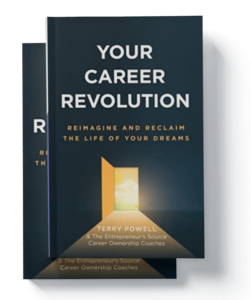
If you are considering a career change, invest in yourself to discover your options, possibilities, and dreams. Chat with one of our coaches to begin your career revolution. To learn more about Career Ownership Coaching™, visit www.entrepreneursource.com or check out our guidebook, “Your Career Revolution: Reimagine and Reclaim the Life of Your Dreams.”
Watch Episodes on YouTube or Listen as a Podcast and more!
















Share this post:
Related Posts
Your Trusted Resource for Career Ownership Coaching™ for helpful hints, best practices, anything related to career ownership.

What happened to Thriving?
As the year comes to a close, many of us pause to reflect. How am I really doing? Is my work helping me grow, or just keeping me occupied? If you’re unsure, you’re not alone. More people across North America are asking these questions than ever before.

What older job seekers should know.
Job searches are taking longer for everyone these days. In September 2026, the average unemployed American had been looking for work for about 25 weeks, according to the U.S. Bureau of Labor Statistics.

Working From Home Gave You a Taste of Control.
Remember those first months of working from home. There was no commute, no need to rush out the door. You could have lunch with your family or take a walk in the middle of the day. Maybe you found you worked best early in the morning or after the kids went to bed.