Season 2, Episode 4: When Work Becomes Toxic:
Is Business Ownership the Exit Ramp?
Your Career Compass from The Entrepreneur’s Source®
When Is It Time to Leave Your Corporate Comfort Zone?
In this episode, host Tamara Loring talks with organizational psychologist Dr. Mike Smith about the idea of the “corporate comfort zone”—what it means, why it feels safe, and when that safety can actually be misleading. They discuss the difference between real security and a false sense of it, how discomfort can motivate you, and the four stages you go through when you leave what’s familiar: comfort, fear, learning, and opportunity.
 They have an open conversation about ageism, downsizing, and building wealth. They explain that looking into options like business ownership is not about giving up stability, but about taking control of your future. They finish by highlighting how a Career Ownership Coach® can help you find blind spots, clarify your goals, and explore your options in a safe and supportive way.
In this episode:
- Why “familiar” and “secure” are not the same thing
- The difference between discomfort and fear—and how to use it
- The four zones: comfort, fear, learning, and opportunity
- Evaluating your career goals
- How a Career Ownership Coach® helps you see what you can’t see alone
Take our Workplace Wellness Assessment
Featured guest: Dr. Mike Smith, organizational psychologist and executive coach, who guides leaders from the C-suite to the front line through purpose discovery and major career transitions—drawing on both academic research and his own move out of the corporate world.
You often sense it before you can describe it. Maybe it’s the Sunday-night feeling in your stomach, or meetings that leave you tired instead of inspired. Maybe it’s a work culture that makes you dread the next email instead of looking forward to your tasks. A toxic workplace doesn’t show up all at once—it builds up slowly, one discouraging moment at a time, until your main goal is just to get through the week.
If this sounds familiar, remember you are not weak, dramatic, or ungrateful. You are a professional whose workplace is no longer helping you grow. The question that comes up—“Is there a better way?”—deserves a real answer.
That’s exactly the conversation Tamara Loring and Dr. Mike Smith have on this episode of Your Career Compass. As Tamara frames the stakes:
“Are you actually dying a slow death? Are you subjecting yourself to a potential corporate expiration date?”
— Tamara Loring
At The Entrepreneur’s Source®, we have spent years helping people in your situation. You are the hero of your own story. We are here to guide you, help you see your options clearly, and support you in making decisions with intention, not out of fear.
Toxic Isn’t the Same as “Hard”
Every job has tough days and feeling uncomfortable while growing is normal. But a toxic environment is different. It’s an ongoing pattern, not just a rough week:
- Chronic disrespect, fear, or favoritism that no amount of effort seems to fix.
- A culture where your values and the organization’s values are constantly at odds.
- Stress that follows you home and starts to affect your health and relationships.
- The slow realization that you’re shrinking yourself to fit a place that isn’t built for who you’re becoming.
Here’s the problem: when a workplace becomes toxic, the feeling of “at least I know what to expect” can keep you stuck much longer than is healthy. Dr. Mike explains this paradox clearly:
“The more comfortable you get in that corporate comfort zone, the quicker it can sneak up on you and put you in a place of discomfort when things no longer align.”
— Dr. Mike Smith
Staying in a place that slowly wears you down is not real security. It’s like having a corporate expiration date you never agreed to.
Why More People Are Eyeing the Exit
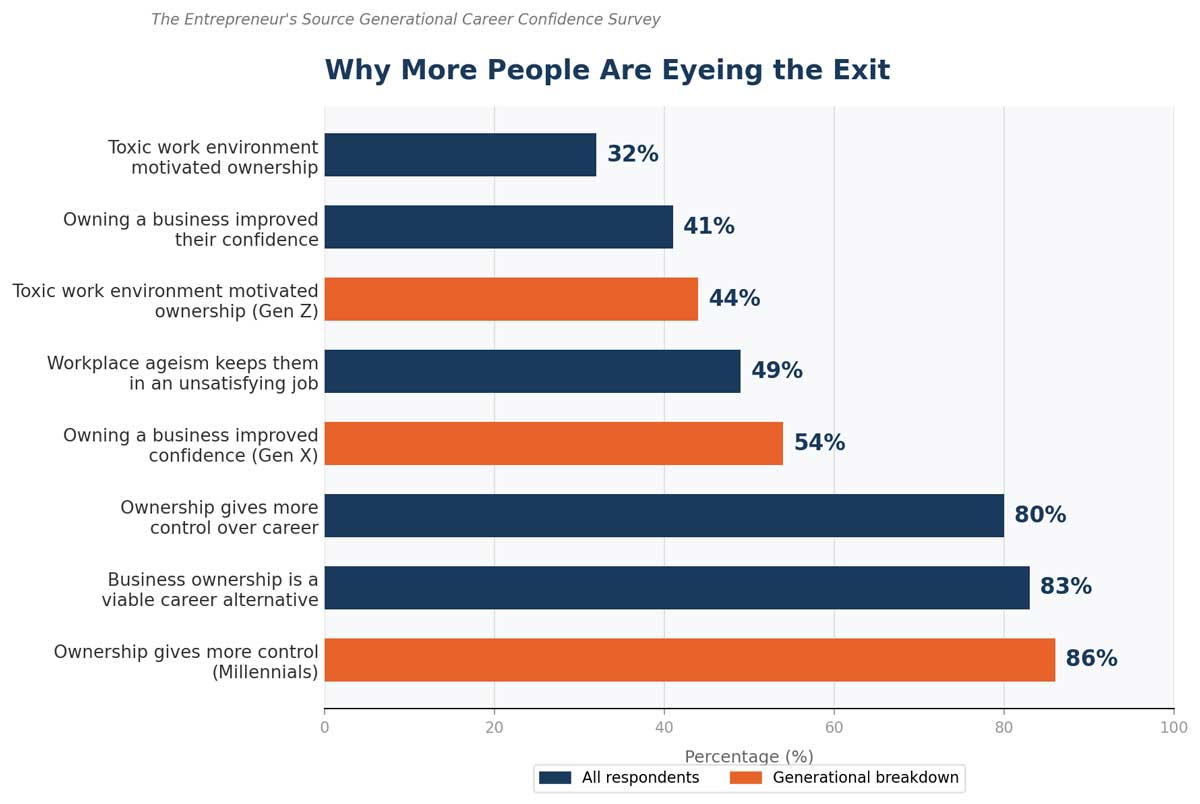
This isn’t just anecdotal. The Entrepreneur’s Source Generational Career Confidence Survey shows the appeal of ownership as an alternative came through clearly:
- 32% of business owners say a toxic work environment was a motivation for striking out on their own, rising to 44% among Gen Z owners.
- 49% of employees say workplace ageism keeps them in a job they find unsatisfying.
- 83% believe business ownership is a viable alternative to a traditional career.
- 80% of employees say ownership gives them more control over their career (86% of Millennials).
- 41% of owners say owning a business improved their confidence (54% among Gen X owners).
The numbers show a clear pattern: people don’t leave tough jobs just because they’re hard. They leave because things no longer fit, and more people now see business ownership as a way to get back the control, respect, and opportunities they lost in their jobs.
Discomfort vs. Fear: Your Most Useful Signal
When you’re in a toxic situation, your gut feelings become stronger, and understanding them is key. It’s important to know the difference between discomfort and fear.
- Fear says: “This is dangerous—retreat to what’s familiar.” It pulls you back toward the very environment that’s draining you.
- Discomfort says: “This is new—pay attention and grow.” Viewed correctly, it’s a nudge to explore whether something better exists.
“Discomfort, when viewed the right way, can seriously be leveraged for motivation to move forward.”
— Dr. Mike Smith
Tamara takes it one step further—reframing discomfort as the doorway to control:
“Instead of being frustrated or scared, you become curious. When you’re curious, you’re starting to take control.”
— Tamara Loring
How you handle those feelings is very important. If you ignore them, they don’t go away—they build up into stress, anxiety, and burnout. If you talk about what you’re feeling and look at your options, you start to find clarity. As Dr. Mike puts it:
“Suppressing causes disease. Expressing causes at ease.”
— Dr. Mike Smith
A Better Question Than “Should I Quit?”
 When your job becomes toxic, your first thought might be, “Should I leave?” But that’s not the best place to start. It’s a reaction, and it skips over what you really want. A better question is, “Does my career actually help me reach my goals?”
Tamara draws the line clearly:
“If your income is capped, your flexibility is limited, and you have no opportunity to build wealth or equity, maybe your corporate career is no longer serving you the way it’s supposed to.”
— Tamara Loring
If you answer “no” to most of these questions—and your workplace is hurting your peace of mind—that’s not a failure. It’s information. It’s a clear sign that it might be time to look at other options, like business ownership, that could give you what you’re missing.
The Four Zones: From Toxic to Opportunity
Leaving a toxic workplace for something better doesn’t happen all at once. Most people go through four stages:
- Comfort Zone — Familiar and predictable, even when it’s quietly harmful. Autopilot lives here.
- Fear Zone — The moment you consider leaving: “What if I fail? What if I’m not qualified?” This is where many people retreat.
- Learning Zone — Push through the fear, and curiosity takes over. You ask better questions, study real options, and gather information.
- Opportunity Zone — Your awareness expands, and you begin to see possibilities that were invisible from inside the old environment. Your comfort zone actually grows.
The goal isn’t to avoid discomfort, but to use it so that a toxic situation pushes you forward instead of keeping you trapped. As Dr. Mike reminds us, this choice affects more than just you:
“Someone out there needs us and what we have to offer the world. If we don’t step into and embrace the change, we’re not just missing out for ourselves—we’re missing out on the opportunity to serve others.”
— Dr. Mike Smith
You Don’t Have to Figure This Out Alone
Trying to solve a toxic work situation on your own—especially late at night in your own thoughts—is tiring and usually doesn’t help. That’s where a Career Ownership Coach® can make a difference. A coach is a trained, neutral guide who cares only about your success, not your employer’s or any specific opportunity. Through Career Ownership Coaching™, a coach can help you:
- Separate genuine discomfort from fear, so you’re deciding from clarity rather than reaction.
- See the blind spots you can’t see yourself—including transferable skills and options you’ve overlooked.
- Clarify your goals and what you actually want your future to look like.
- Build a realistic, step-by-step plan that respects your financial and family needs.
“If we knew our own blind spots, they wouldn’t be blind spots. A coach can stop you in your tracks and have you look at things from a different perspective.”
— Tamara Loring
It’s also a reminder to keep an open mind, especially when you feel like you already have all the answers. As Tamara likes to say,
“It’s what we learn after we think we know it all that really counts.”
— Tamara Loring
Explore, Don’t Jump
 Business ownership can be a real way out of a toxic workplace, but it’s not wise to quit right away. The best approach is to explore your options while you’re still working. Looking at new paths doesn’t mean you have to commit—it’s just about learning. Here’s how you can begin:
- Take stock of your goals. Be honest about where your goals are capped, where you are now.
- Give yourself permission to be curious. Express the nagging feelings instead of suppressing them.
- Talk to a Career Ownership Coach®. Have a real conversation with someone trained to listen, challenge, and guide—with no agenda except helping you design your future.
Dr. Mike’s encouragement for anyone standing at that edge:
“Give yourself enough grace, believe in yourself, and bet on yourself enough to at least step into that exploration stage.”
— Dr. Mike Smith
Whether you choose business ownership or find another way to change your situation, you win—because you’re no longer stuck in a place that holds you back. You’re moving out of a toxic comfort zone and into a space where you can learn and find new opportunities.
Take the Workplace Wellness Assessment
You don’t have to settle, stay stuck, or go through this alone. The Entrepreneur’s Source® is here to support you, step by step, with each conversation, insight, and decision. Tamara sums it up best:
“You don’t have to settle for the path of least resistance. Our goal here is to really empower you and show you a better way.”
— Tamara Loring
Share this post:
Related Posts
Your Trusted Resource for Career Ownership Coaching™ for helpful hints, best practices, anything related to career ownership.

The Unemployment Rate Isn’t Telling the Truth
You have heard the headlines. Unemployment is around 4%. Economists call it "full employment." The job market, we are told, is strong. So why does your job search drag on for months?

After the Layoff
It usually begins the same way. You get a calendar invite with no details. Your manager avoids eye contact on the video call. Then you hear the words that suddenly make your career part of your past.

Rest alone won’t solve burnout if your job is the real issue.
You finally took a break. Maybe it was a long vacation, take some time between jobs, or even a full career pause. You caught up on sleep, unplugged, and started to feel like yourself again. But once you returned to work, the exhaustion crept back in within just a few weeks.