
Welcome to the Era of the Forever Layoff
— And Why It Changes Everything About How You Plan Your Career
There was a time when a layoff was an event. Something went wrong. Revenue slipped, a product failed, a market turned, and the company made a painful correction. You could see it coming, and once it passed, the ground felt solid again.
That era is over.
In May 2026, Cloudflare cut more than 20% of its workforce — roughly 1,100 people. Not because the company was struggling. CEO Matthew Prince wrote in The Wall Street Journal that the company had posted record revenue growth, strong free cash flow, and an unprecedented number of new customers. He also noted the company could not find another example in U.S. business history of a public company growing at more than 30% that laid off more than 20% of its people. Then he added the line that should stop every professional in North America cold: what they did is likely going to become the norm.
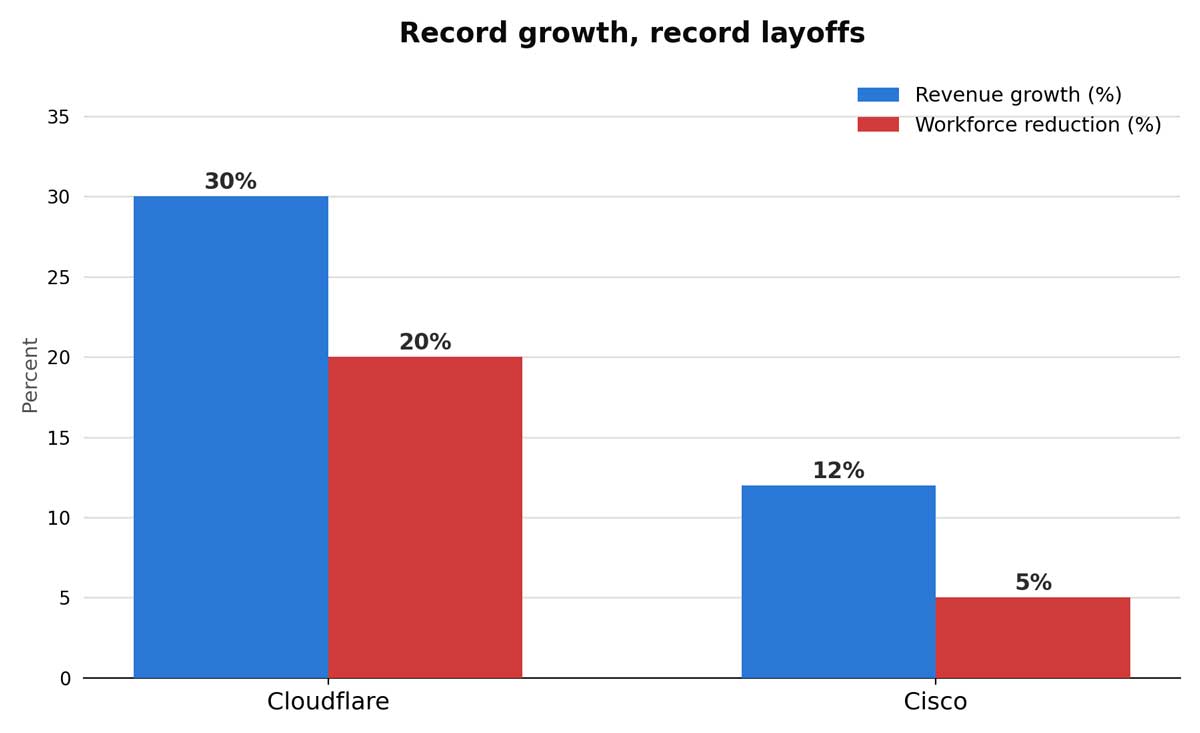
Days earlier, Cisco had already proven his point. The company reported record fiscal third-quarter revenue of $15.8 billion, up 12% year over year, with double-digit growth on both the top and bottom lines — and announced it was cutting fewer than 4,000 jobs, less than 5% of its roughly 86,000-person workforce. CEO Chuck Robbins framed it as a shift of investment toward the areas where long-term value creation is strongest.
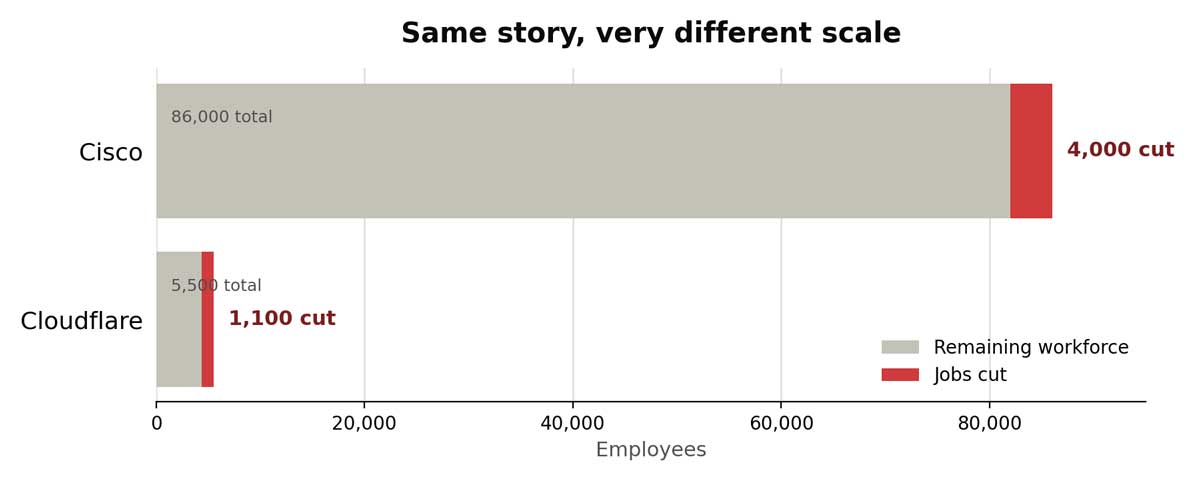
Read that again. Record revenue. Record growth. Record layoffs. In the same press release.
The New Math: Performance No Longer Protects You
For decades, the unspoken agreement in corporate North America went something like this: work hard, deliver results, help the company grow, and the company will keep you. It was never a written contract, but most people organized their entire adult lives around it — mortgages, tuition plans, retirement timelines, identity.
The 2026 labor market has quietly voided that agreement.
 The data is not subtle. Through the first half of the year, AI had been explicitly cited in more than 100,000 layoff announcements — roughly 23% of every cut tracked across the entire economy, and already far beyond the 54,836 attributed to AI in all of 2025.
Meanwhile, the door out is not matched by a door in. Hiring plans fell 69% in April, to 10,049 from 32,826 in March, and were down 38% from the same month a year earlier. Analysts have a name for this environment: low-hire, low-fire. Now it is becoming low-hire, always-fire.
Harvard’s Joseph Fuller describes what companies are doing as continuous tuning — smaller, recurring adjustments rather than one dramatic correction. Not a storm you wait out. A climate you live in.
What Continuous Tuning Feels Like From a Cubicle.
Here is what the earnings-call language does not capture. When cuts become continuous, the psychological experience of employment changes fundamentally. You are never post-layoff. You are always pre-layoff.
We are seeing the behavioral consequences everywhere. Professionals are staying in roles they have outgrown because the devil they know feels safer than the market they fear — a pattern often called job hugging. They are declining internal moves, avoiding visibility, and quietly accepting compensation and benefit erosion because raising a hand feels like volunteering for the list. Experienced professionals in their 40s, 50s, and 60s are absorbing the additional weight of age bias in a market that keeps rebranding it as a skills conversation.
Findings from The Entrepreneur’s Source® Generational Career Confidence Survey point to the same underlying truth across every generation in the workforce: people are far less confident in the durability of traditional employment than they were even a few years ago, and that erosion of confidence is not limited to any one age group. Young professionals watching entry-level pipelines narrow and seasoned executives watching middle management disappear are arriving at the same conclusion from opposite ends of a career.
The conclusion is this: if the company can continuously tune, so can you. The difference is that most people have never been shown how.
The Real Risk Is the One Nobody Names.
 When people hear the words Career Ownership, the instinctive reaction is that it sounds risky. Uncertain. A leap.
But look honestly at the alternative. In traditional employment, one person — someone you may never have met, working from a spreadsheet in another time zone — can eliminate your income in a single meeting, in a quarter when your company set revenue records. Your income has exactly one customer. Your equity in the enterprise you helped build is zero. Your lifestyle is governed by someone else’s calendar. And your wealth accumulation depends on a relationship that both parties now understand to be temporary.
That is not safety. That is concentration risk with a direct deposit attached.
A Different Framework for a Different Era.
This is where Career Ownership Coaching™ starts from a different question. Not “what job should I get next?” but “what do I actually want my life to look like, and what vehicle gets me there?”
Most people have simply accepted whatever combination a job offer handed them and adjusted their expectations to fit. The work of Career Ownership Coaching™ is to reverse that order — to define the destination first, then explore every possible route, including options most professionals never seriously examine.
The Window Is Open Right Now.
 Here is the uncomfortable timing question. The professionals most capable of designing a self-directed future are usually the ones with the most to lose by waiting significant experience, real severance capacity, transferable expertise, and industry relationships still warm.
Those assets have a shelf life. They are worth the most before the tuning reaches your team, not after.
Exploring Career Ownership does not mean resigning tomorrow. It means doing what every prudent organization is already doing to you — evaluating options continuously instead of waiting for certainty that will never arrive. Prince said the industry would not wait. Robbins said the winners would shift investment continuously. They were describing corporate strategy. It is also, exactly, personal strategy.
The forever layoff is not going away. The only real question is whether you spend the next decade as the variable being tuned, or as the person doing the tuning.
A conversation with a Career Ownership Coach® costs nothing but an hour of honesty about what you actually want. Given what an unplanned exit costs, that may be the best-priced hour in your career.
Request your free guide on the benefits of working with a Career Ownership Coach®
 About Your Career Revolution
Our mission is to help individuals explore self-sufficiency as an alternative career.
We help them define their Income, Lifestyle, Wealth, and Equity goals and provide education on the best ways to achieve them. We don’t sell franchises – we help people achieve their dreams of self-sufficiency through business ownership. The approach is different, the experience is different. And it works.
Order on AMAZON
Learn More About Career Ownership Coaching™
If you are considering a career change, invest in yourself to discover your options, possibilities, and dreams. Chat with one of our coaches to begin your career revolution. To learn more about Career Ownership Coaching™, visit www.entrepreneursource.com or check out our guidebook, “Your Career Revolution: Reimagine and Reclaim the Life of Your Dreams.”
Watch Episodes on YouTube or Listen as a Podcast and more!
















Share this post:
Related Posts
Your Trusted Resource for Career Ownership Coaching™ for helpful hints, best practices, anything related to career ownership.

The Unemployment Rate Isn’t Telling the Truth
You have heard the headlines. Unemployment is around 4%. Economists call it "full employment." The job market, we are told, is strong. So why does your job search drag on for months?

After the Layoff
It usually begins the same way. You get a calendar invite with no details. Your manager avoids eye contact on the video call. Then you hear the words that suddenly make your career part of your past.

Rest alone won’t solve burnout if your job is the real issue.
You finally took a break. Maybe it was a long vacation, take some time between jobs, or even a full career pause. You caught up on sleep, unplugged, and started to feel like yourself again. But once you returned to work, the exhaustion crept back in within just a few weeks.