Feeling like your job search will never end?
The problem isn’t you—it’s the system.
 If you’ve been searching for a job for six months or longer, you might be wondering: Is it my fault?
You’ve applied to countless jobs and updated your résumé over and over. You’ve had interviews that seemed promising, only to get no response. Friends and family are surprised you’re still looking, given your experience. Sometimes, you even skip social events to avoid talking about your search.
At The Entrepreneur’s Source®, we hear stories like yours every week. For more than 41 years, we’ve helped people navigate career changes. Here’s what we want you to know: you are not broken. The job market is different now, and the old rules just don’t work anymore.
The statistics show you’re not alone
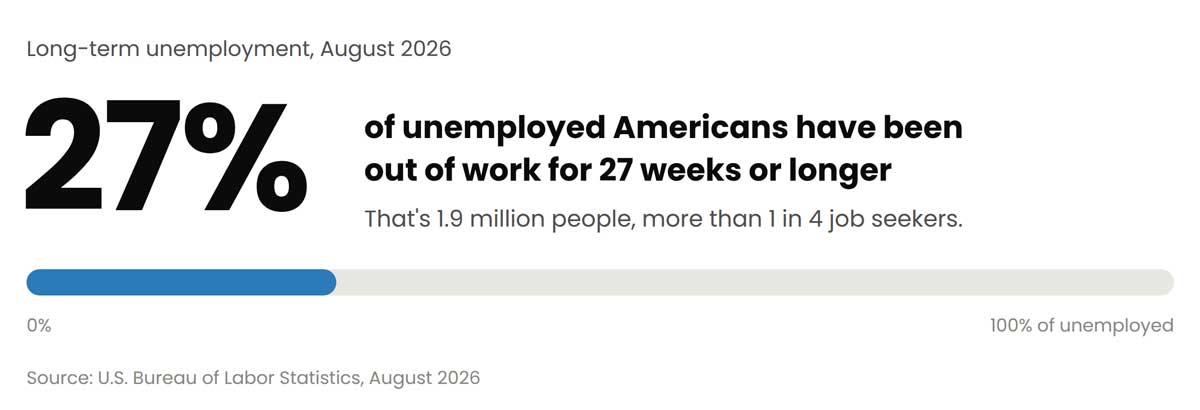
The U.S. Bureau of Labor Statistics reported that 1.9 million Americans had been unemployed for 27 weeks or more in August 2026. That’s 27% of people out of work. More than one in four job seekers has been searching for over six months.
What’s unusual right now is that overall unemployment is still low. In the past, having this many long-term job seekers usually meant the country was in or just leaving a recession. But today, there’s no recession causing it.
This is more important than it seems. Ofer Sharone, a sociologist at the University of Massachusetts Amherst, found that when job seekers can’t find an obvious reason for their struggles, they often blame themselves. That self-blame chips away at confidence, which is exactly what you need during a long search.
 Business Insider recently featured a man in his 40s with over 20 years of experience who’s been job hunting since 2024. He said he’d heard “It’s not you, it’s us” so often that he started to question if it really was him.
It’s not his fault. And it’s not yours either.
What’s actually happening
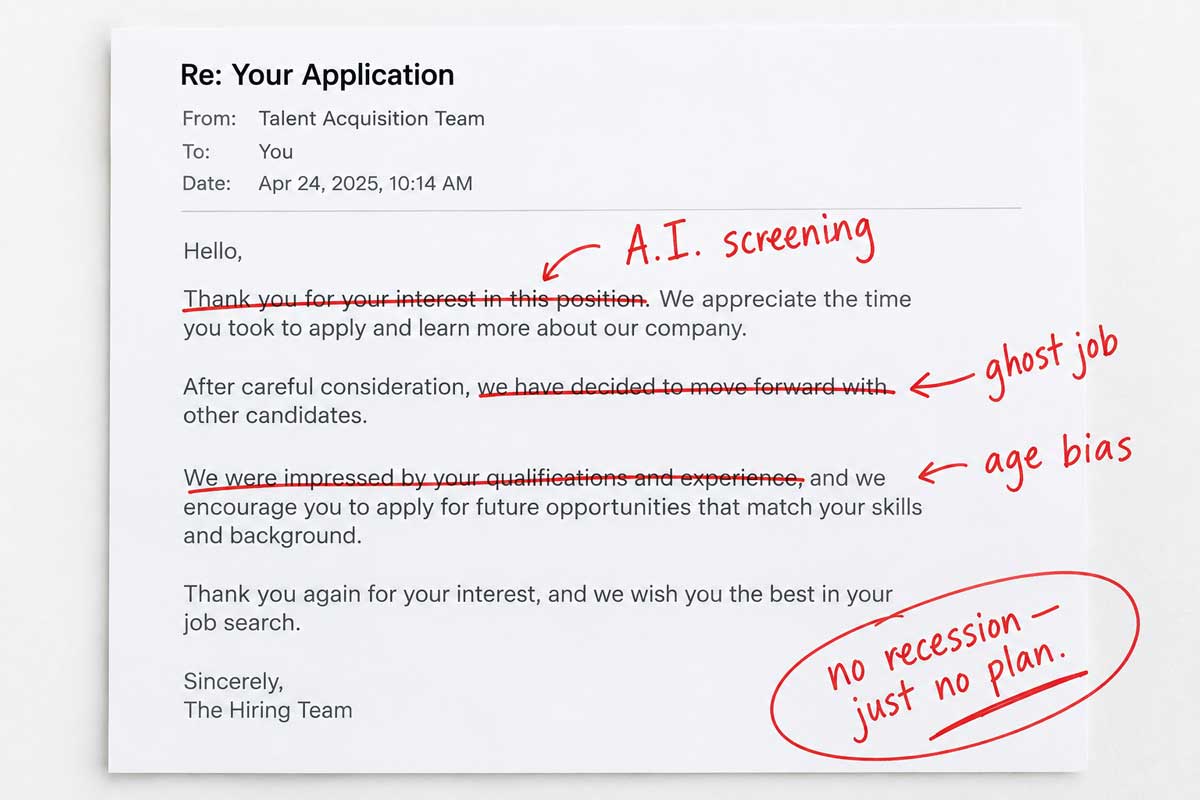
Job seekers are facing several challenges at once. After the hiring surge during the pandemic, companies slowed down hiring, and that slowdown has lasted longer than expected. Artificial intelligence is changing which jobs exist and how many people are needed. Age discrimination, even though it’s illegal, still affects who gets interviews. And “ghost jobs”—listings companies post but never plan to fill—waste your time and hope.
People feel these pressures every day. The TES Generational Career Confidence Survey found that 49% of employees say ageism keeps them stuck in jobs they don’t enjoy. And 61% of adults believe owning a business is the best way to protect their careers from being replaced by AI.
The toughest part is that none of these reasons show up in a rejection email. You either get silence or a generic response, and you end up blaming yourself.
None of this is your fault. But here’s what matters most: waiting for the job market to improve isn’t a plan. Things might get better, or they could get worse. You can’t control that. What you can control is whether you keep following the old rules or take a step back to consider all your options.
Try asking a different question
 Most job seekers keep asking: How do I get hired? It’s a reasonable question, but after months of no answers, it might not be the best one.
A better question is: What do I really want my life to look like, and what are all the ways I could make that happen?
That’s a big question, and it’s tough to answer by yourself—especially when you’re feeling tired. This is exactly what a Career Ownership Coach® can help you figure out.
What a Career Ownership Coach® really does
A Career Ownership Coach® isn’t a résumé writer, recruiter, or job placement service. They won’t tell you what to do. Instead, they help you figure out what’s right for you.
Career Ownership Coaching™ begins with you, not with job listings. Your coach helps you get clear on four things: the income you need, the lifestyle you want, the wealth you hope to build, and the equity you want to own. At The Entrepreneur’s Source®, we call this Income, Lifestyle, Wealth, and Equity™, or I.L.W.E.™. Once you know your I.L.W.E.™ goals, you can compare every option—whether it’s a new job, a career change, or owning a business.
After that, your coach helps you explore your options. Many people never really think about owning a business because they assume it’s not for them. A coach helps you look at this option honestly and without pressure, along with every other path. Some people find that business ownership matches their goals better than they expected. Others realize a traditional job is still the best fit, but now they search with more clarity and less stress.
This process is designed to fit your real life. Sessions are one-on-one and move at your speed. You’ll talk about your situation, what you’ve tried, and what’s been holding you back. Then, you’ll go through proven steps to explore your options, with your coach making sure each one matches your goals—not theirs. There’s no deadline and no quota.
One client shared this about her coach: “She doesn’t simply tell you what you should do. She helps you discover the right path for yourself.” That’s exactly the point.
Why this is important right now
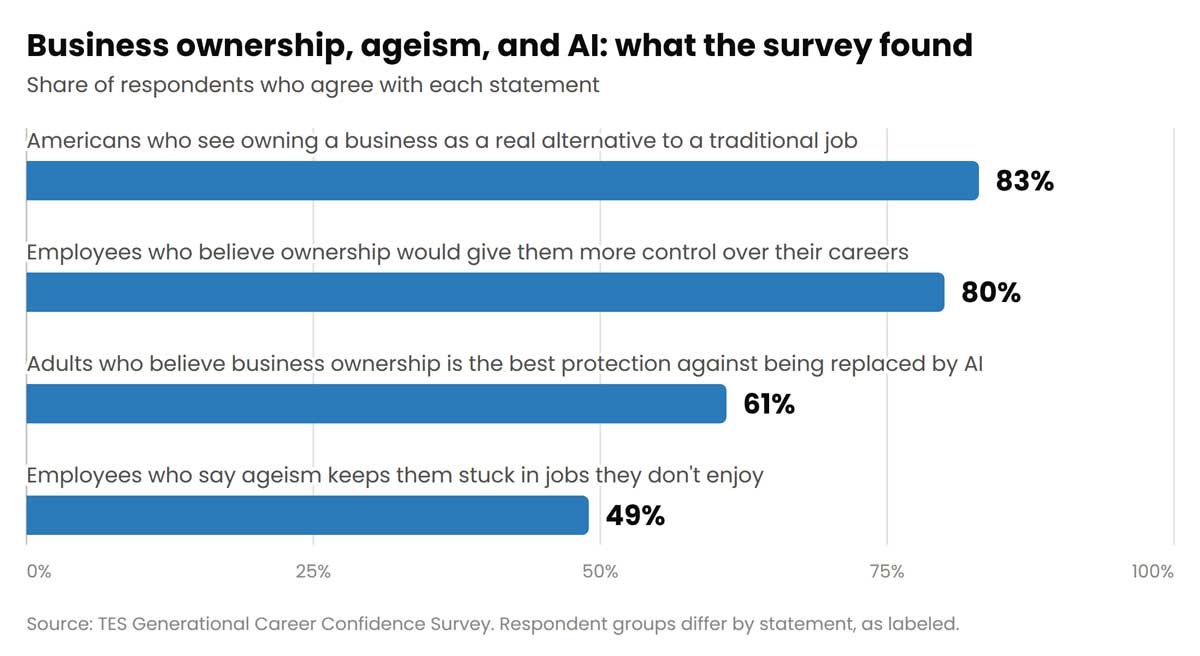
The TES Generational Career Confidence Survey found that 83% of Americans see owning a business as a real alternative to a traditional job. And 80% of employees believe ownership would give them more control over their careers. People want options, but most don’t have anyone to guide them.
That’s where we come in. We’re not the hero of your story. You are. Our role is to walk beside you, ask the right questions, and help you see the possibilities you may have missed while you were busy sending out applications.
Coaching with The Entrepreneur’s Source® is free. No pitch, no pressure. It’s a conversation about your goals and your options, guided by someone who has helped thousands of people move from Employment to Empowerment™.
Your next step
 If you’ve spent months job searching and it feels like a nightmare, you don’t have to keep hitting refresh on the same job boards, hoping this week will be different.
Take a few minutes to find out whether working with a coach is right for you. Our free assessment, Is Working With a Career Ownership Coach Right for You?, is a simple first step.
Thousands of people have been where you are now. Many of them are running businesses today. Others found roles that finally fit. What they share is that they stopped searching alone.
You’ve been asking, “Is it me?” for long enough. Let’s ask a better question together.
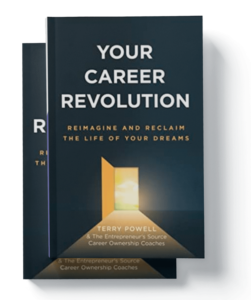 About Your Career Revolution
Our mission is to help individuals explore self-sufficiency as an alternative career.
We help them define their Income, Lifestyle, Wealth, and Equity goals and provide education on the best ways to achieve them. We don’t sell franchises – we help people achieve their dreams of self-sufficiency through business ownership. The approach is different, the experience is different. And it works.
Order on AMAZON
Learn More About Career Ownership Coaching™
If you are considering a career change, invest in yourself to discover your options, possibilities, and dreams. Chat with one of our coaches to begin your career revolution. To learn more about Career Ownership Coaching™, visit www.entrepreneursource.com or check out our guidebook, “Your Career Revolution: Reimagine and Reclaim the Life of Your Dreams.”
Watch Episodes on YouTube or Listen as a Podcast and more!
















Share this post:
Related Posts
Your Trusted Resource for Career Ownership Coaching™ for helpful hints, best practices, anything related to career ownership.

The Unemployment Rate Isn’t Telling the Truth
You have heard the headlines. Unemployment is around 4%. Economists call it "full employment." The job market, we are told, is strong. So why does your job search drag on for months?

After the Layoff
It usually begins the same way. You get a calendar invite with no details. Your manager avoids eye contact on the video call. Then you hear the words that suddenly make your career part of your past.

Rest alone won’t solve burnout if your job is the real issue.
You finally took a break. Maybe it was a long vacation, take some time between jobs, or even a full career pause. You caught up on sleep, unplugged, and started to feel like yourself again. But once you returned to work, the exhaustion crept back in within just a few weeks.