
The Unemployment Rate Isn’t Telling the Truth

The 4% Unemployment Rate Isn’t Telling You the Whole Story
You have heard the headlines. Unemployment is around 4%. Economists call it “full employment.” The job market, we are told, is strong.
So why does your job search drag on for months? Why did the raises stop? Why is everyone you know holding on to the job they have, even the ones who are miserable there?
You are not imagining it. According to Gallup Chairman Jim Clifton, the 4% number measures something much narrower than most people believe. He calls the gap between that number and real life “a national misunderstanding.” And once you see how the number is built, the market you are living in starts to make a lot more sense.
What the 4% Actually Counts
The monthly unemployment rate comes from a government survey of about 60,000 households. It is good data. But it only counts you as unemployed if you have no job and actively looked for one in the past four weeks.
For August 2026, the Bureau of Labor Statistics reported an unemployment rate of 4.1%. That works out to about 7.0 million people.
Here is who that number leaves out:
- About 441,000 “discouraged workers” who want a job but have stopped looking because they believe none are available.
- About 4.4 million people working part time because they cannot find full-time work.
- About 5.7 million people who are not in the labor force at all but say they want a job.
The government does track a broader measure, called U-6. It adds in discouraged workers, others on the margins of the labor force, and part-timers who want full-time hours. For August 2026, U-6 was 7.7%. That is nearly double the headline rate, and it is the number Clifton says gets “much closer to the truth and pain on the ground.”
The 10 Million Nobody Counts
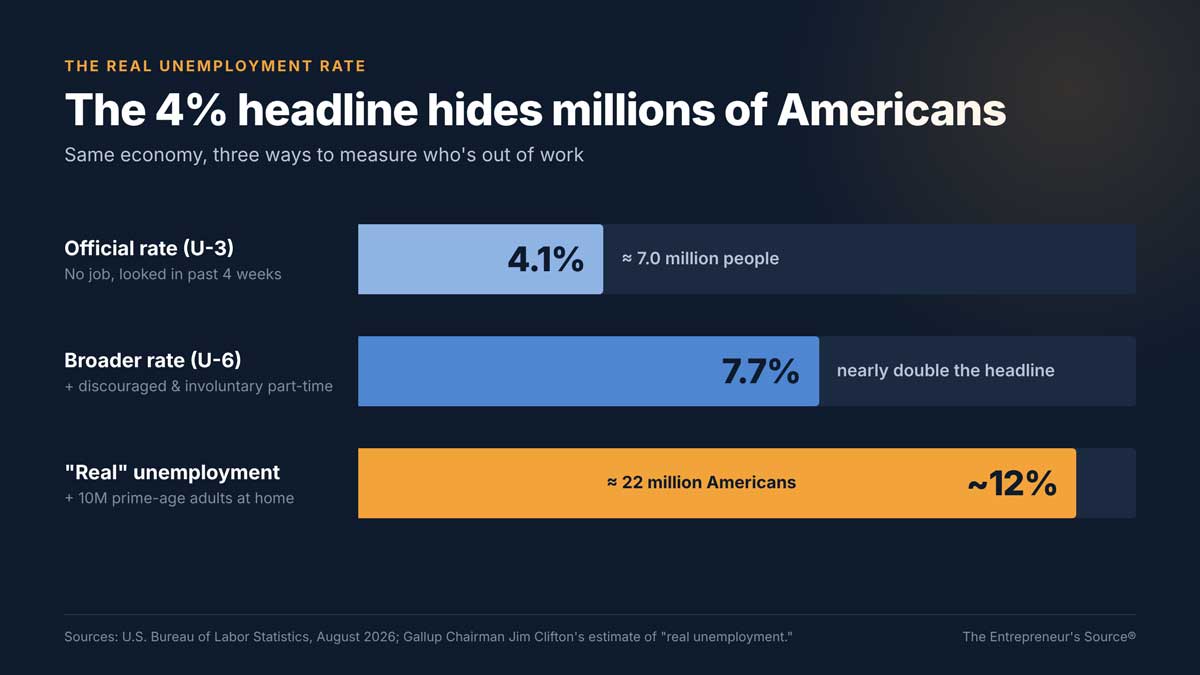
Clifton goes one step further. He points to prime working-age adults, ages 25 to 54, who are at home and not working. By his estimate, that includes about 6.5 million men and 4 million women. These figures exclude people raising children or caring for family.
Add them to the official count, and Clifton puts “real unemployment” at roughly 12%. That is about 22 million Americans. His research finds that most of the people at home and not working would love to have a good job, one that fits their education, training, and strengths.
Meanwhile, the people who are still looking are looking longer. The BLS reports that 1.9 million Americans have been unemployed for 27 weeks or more. That is 27% of everyone who is unemployed. More than one in four job seekers has been searching for over six months.
Why This Matters for Your Career
 Numbers shape decisions. When leaders, employers, and investors believe the country is at full employment, they act like it. There is less urgency to hire. Less pressure to raise wages. Less reason to invest in the people already on the payroll.
That is the low-hire, low-fire market many professionals are stuck in right now. Companies are not cutting deeply, but they are not adding either. If you are employed, your leverage is smaller than the headline suggests. If you are searching, the competition is larger than the headline suggests. Employers can wait. Many workers feel they cannot.
Clifton also notes that thought leaders and technology executives are now predicting major job loss as AI takes over human work. If the baseline is already 22 million people without a good job, that wave does not land on a strong foundation.
Gallup has surveyed people around the world for decades, and Clifton says the finding is consistent. What people want most is a good job. Everything else, including family, home ownership, and serving others, comes after it. Dignity and self-worth are tied to work. That is why a misleading number is not just a policy problem. It is a personal one.
A Different Way to Measure Security
 For decades, a traditional job was the safe choice. You showed up, did good work, and the company took care of the rest. Today, that safety is harder to find. Benefits are shrinking. Job searches are stretching. AI is reaching into roles that once felt untouchable. And the number everyone uses to describe the market is hiding how many people are already on the outside.
A growing number of professionals are responding by taking control of their own career path. The TES Generational Career Confidence Survey found that 83% of Americans see business ownership as a viable alternative to a traditional career. Two-thirds, 66%, believe ownership offers more job security than a job. And 80% of employees say ownership gives them more control over their career.
That is what Career Ownership means. Instead of measuring security by whether an employer keeps you, you measure it by what you are building for yourself. The Entrepreneur’s Source® frames that through four goals: Income, Lifestyle, Wealth, and Equity™. Income is what you earn today. Lifestyle is the freedom to shape your time. Wealth is what you accumulate over the years. Equity is the value of something you own that can grow and one day be sold or passed on.
A traditional job usually offers the first one. Career Ownership is designed to pursue all four.
How a Career Ownership Coach® Helps
 Deciding whether Career Ownership is right for you is a big question. It touches your finances, your family, and your identity. Most people have never been given a safe place to explore it, so they either dismiss the idea or stay stuck. That is where a Career Ownership Coach® comes in.
A Career Ownership Coach® does not sell you a business. Instead, the coach acts as a guide. The process starts with you: your goals, your needs, and your expectations for Income, Lifestyle, Wealth, and Equity™. From there, the coach helps you explore options you may never have considered, with education and clarity rather than pressure. Many clients discover possibilities that fit their strengths far better than the job they were clinging to.
The coaching is at no cost to you, and there is no obligation. The goal is simple: help you make an informed decision about your future instead of letting a misleading number make it for you.
Start With the Truth
Clifton’s advice to the nation is to stop relying on a single statistic and start with the truth. That is good advice for your career, too.
If the real job market is tougher than the headlines say, then the smartest move is to understand your own exposure. Take the Career Threats Assessment to see how AI, ageism, a longer job search, and a low-hire market could affect your path, and what you can do about it. Then, if you are ready to explore, connect with a Career Ownership Coach® and start writing your own numbers.
About Your Career Revolution
Our mission is to help individuals explore self-sufficiency as an alternative career.
We help them define their Income, Lifestyle, Wealth, and Equity goals and provide education on the best ways to achieve them. We don’t sell franchises – we help people achieve their dreams of self-sufficiency through business ownership. The approach is different, the experience is different. And it works.
Order on AMAZON
Learn More About Career Ownership Coaching™
If you are considering a career change, invest in yourself to discover your options, possibilities, and dreams. Chat with one of our coaches to begin your career revolution. To learn more about Career Ownership Coaching™, visit www.entrepreneursource.com or check out our guidebook, “Your Career Revolution: Reimagine and Reclaim the Life of Your Dreams.”
Watch Episodes on YouTube or Listen as a Podcast and more!
















Share this post:
Related Posts
Your Trusted Resource for Career Ownership Coaching™ for helpful hints, best practices, anything related to career ownership.

Working From Home Gave You a Taste of Control.
Remember those first months of working from home. There was no commute, no need to rush out the door. You could have lunch with your family or take a walk in the middle of the day. Maybe you found you worked best early in the morning or after the kids went to bed.

Your Loyalty Used to Protect You.
Are you approaching 10, 15, or even 20 years at your company. You have trained new employees and understood every process and its purpose. You expect your years of service would matter if layoffs happen.

After the Layoff
It usually begins the same way. You get a calendar invite with no details. Your manager avoids eye contact on the video call. Then you hear the words that suddenly make your career part of your past.