
The Age Stereotype
The Age Stereotype Nobody Talks About Is “Resistant to Change”
When people talk about age bias at work, the focus is usually on technology. Many assume that experience and adaptability cannot go together, and that the person who knows the most about the job is often seen as the least able to do it differently.
Recent AARP data shows the tech stereotype exists, but it may not be the most harmful one.
What the data actually says
In AARP’s survey, nearly two-thirds 64%) said they had seen or experienced age discrimination at work. Among that group, 91% said such discrimination is common, including 36% who called it very common. More than one in five (22%) said they feel they are being pushed out of their jobs because of their age.
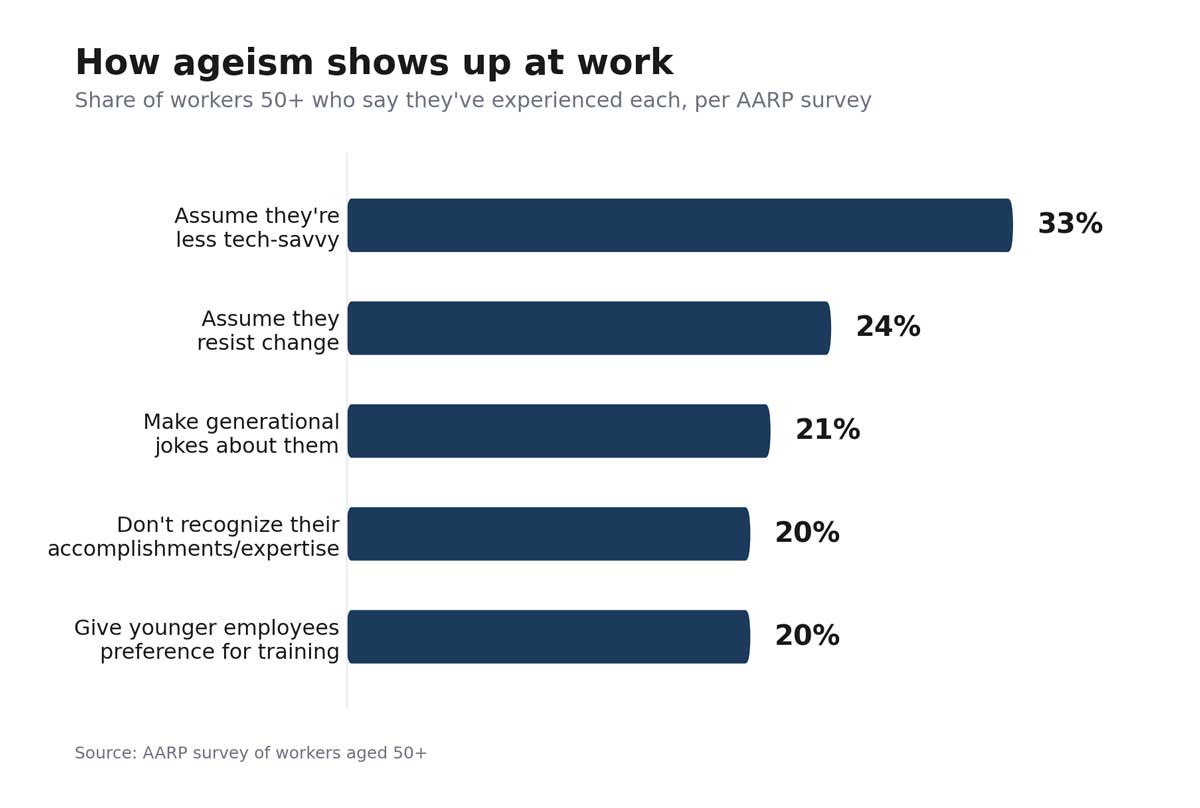
The survey also looked at more subtle forms of bias. The most common was the belief that older employees are less tech-savvy, reported by 33%. Next, 24% said there is an assumption that older workers resist change. Other issues included generational jokes (21%), not recognizing accomplishments and expertise (20%), and giving younger employees preference for training (20%).
The tech stereotype often makes the news. The idea that older workers resist change deserves more attention, not because it is more common, but because it is harder to address.
Why “resistant to change” is the label that sticks
 If someone doubts your skills, you can prove them wrong by learning the new platform, completing the work, and adding the credential to your profile. Evidence can change this kind of assumption over time.
There is no certificate for open-mindedness. Being called “resistant to change” is not about your skills, but about your character. This label often sticks to decisions you were not involved in, like projects you were not offered, changes you heard about later, or opportunities given to others because people assumed you would object.
This label is almost impossible to disprove. If you question a plan, it is seen as proof you resist change. If you go along with it, people may see you as disengaged. Either way, the label seems to confirm itself, which is why it sticks.
“Deciding to build something of your own at 55 is not the behavior of someone who resists change. It may be the most decisive thing a person does in their working life.”
The record points the other direction.
AARP and LinkedIn looked at how workers are building new skills. In five years, the number of workers aged 50 and older listing skills like AI grew by 25%, almost twice as fast as among younger workers. This does not fit the idea of a group avoiding change.
AARP’s Multigenerational Workforce research adds more insight. Of the older workers surveyed, 86% said mentorship was important for their growth. When working with younger colleagues, 87% said they could share their experience, 85% said it brought new perspectives, 83% said it helped them understand different ways of communicating, and 78% said it increased creativity at work. Younger colleagues also said they benefited from these relationships.
These are self-reported attitudes, not direct measures of performance. Still, they show that older workers see themselves as curious and open, not stuck in their ways.
What the label actually costs
Being labeled inflexible does not just hurt feelings. The real cost is the limited opportunities that come after.
In the TES Generational Career Confidence Survey, 49% of employees said workplace ageism keeps them in an unsatisfying job. Nearly half of the workforce reported that a stereotype is part of why they stay somewhere they do not want to be.
 Think about that for a moment. The people most often called resistant to change are often the ones who feel least able to make a change themselves. The label is not about personality; it is about opportunities that have quietly disappeared.
A different question to ask
If you have been given this label, you might want to argue and list every new system you have learned or process you have improved. But this rarely changes minds, because the label was never really about proof.
A better question to ask is: What would you do if no one made this assumption about you?
According to the TES Generational Career Confidence Survey, 83% of people said owning a business is a real alternative to a traditional job. Eighty percent said ownership gives more control over their career, and 66% said it provides more job security. Among Millennials, 86% valued this sense of control. These are beliefs about what ownership can offer, not promises, but they show that many people already see this path clearly.
Career Ownership Coaching™ helps people explore the space between where they are and where they want to be. A Career Ownership Coach® does not give you a ready-made plan. Instead, the process starts by looking at what you want your Income, Lifestyle, Wealth, and Equity™ to be, and then explores options to reach those goals. Most people who start are not sure if business ownership is right for them. That uncertainty is normal and is where the process begins.
The journey from Employment to Empowerment™ usually does not begin with certainty. It begins with asking the question that the label was meant to keep you from considering.
If you have been told for years that you resist change, think about what it would mean to make a change on your own terms. Talking with a Career Ownership Coach® is free and does not require any commitment, so it is a low-risk way to begin.
See how comfortable you are with taking risks: Our Risk Assessment takes just 2 minutes.
 About Your Career Revolution
Our mission is to help individuals explore self-sufficiency as an alternative career.
We help them define their Income, Lifestyle, Wealth, and Equity goals and provide education on the best ways to achieve them. We don’t sell franchises – we help people achieve their dreams of self-sufficiency through business ownership. The approach is different, the experience is different. And it works.
Order on AMAZON
Learn More About Career Ownership Coaching™
If you are considering a career change, invest in yourself to discover your options, possibilities, and dreams. Chat with one of our coaches to begin your career revolution. To learn more about Career Ownership Coaching™, visit www.entrepreneursource.com or check out our guidebook, “Your Career Revolution: Reimagine and Reclaim the Life of Your Dreams.”
Watch Episodes on YouTube or Listen as a Podcast and more!
















Share this post:
Related Posts
Your Trusted Resource for Career Ownership Coaching™ for helpful hints, best practices, anything related to career ownership.

The Unemployment Rate Isn’t Telling the Truth
You have heard the headlines. Unemployment is around 4%. Economists call it "full employment." The job market, we are told, is strong. So why does your job search drag on for months?

After the Layoff
It usually begins the same way. You get a calendar invite with no details. Your manager avoids eye contact on the video call. Then you hear the words that suddenly make your career part of your past.

Rest alone won’t solve burnout if your job is the real issue.
You finally took a break. Maybe it was a long vacation, take some time between jobs, or even a full career pause. You caught up on sleep, unplugged, and started to feel like yourself again. But once you returned to work, the exhaustion crept back in within just a few weeks.