
Breaking Free from Self-Sabotage: Overcoming Negative Thinking
In this pilot episode of Career Compass, host Tamara Loring and guest Dr. Mike Smith talk about self-sabotage and negative thinking.
From jaw-dropping stats about the American workforce and the psychological reasons behind imposter’s syndrome to the difference between self-sabotage and battered work syndrome, and four strategies for overcoming negative thinking… no stone is left unturned!
Tune in to learn about an important question you should ask yourself and key steps you should take to get unstuck and don’t let self-sabotage stop you whenever you have to deal with it.
- Host Tamara Loring kicks the episode off mentioning a 2023 Gallup poll that reported that only a third of Americans feel engaged at work.
- A Zippia survey of a thousand people revealed that at least half of the workforce don’t like their job at all.
- The cause of this? The disengagement is caused by the lack of the freedom for people to be themselves.
- Tamara cites the late Brian Klemmer who claimed that if how-tos were enough, we’d all be skinny, rich, and happy…
- Tamara asks Dr. Mike Smith about self-sabotage – and why people expect different results even though they take the same action over, and over, again.
- Dr. Smith touches upon the relationship between self-sabotage and negative thinking.
- Dr. Smith shares a story of experiencing the so-called imposter’s syndrome and self-doubting himself – including the key questions his wife asked him and that enabled him to step away from self-doubt.
- Feeling like an imposter? Tamara suggests sitting back and saying “I’m here for a reason. I was given this position/responsibility for a reason!”.
- Fundamentally, we form self-doubting thoughts because of our need for societal acceptance.
- We crave being part of something bigger than ourselves to the point that we question whether we would fit in and would be able to contribute in a meaningful way.
- Dr. Smith explains the psychology behind imposter syndrome and how it can be stopped.
- There are a couple of things that can be your north star and help you get rid of self-doubt – Dr. Smith goes over what you should focus on to accomplish that.
- Tamara and Dr. Smith discuss the concept of battered career syndrome.
- Self-sabotage is something that is internally initiated and carried out by you as a person, while the battered work syndrome is driven by external circumstances.
- Dr. Smith lists four different strategies that you can use to overcome negative thinking.
- Remember: never be afraid to step into and share your expertise, your wisdom, your passion, and the school of hard knocks that you’ve gone through in life.
- According to Tony Robbins everyone periodically goes into a period of feeling sad, depressed and/or emotionally beat up – the difference is between how quickly you pull yourself up versus how long you stay in that negative phase.
Mentioned in This Episode:
McClelland’s Human Motivation Theory
About Your Career Revolution
 Our mission is to help individuals explore self-sufficiency as an alternative career.
We help them define their Income, Lifestyle, Wealth, and Equity goals and provide education on the best ways to achieve them. We don’t sell franchises – we help people achieve their dreams of self-sufficiency through business ownership. The approach is different, the experience is different. And it works.
Order on AMAZON
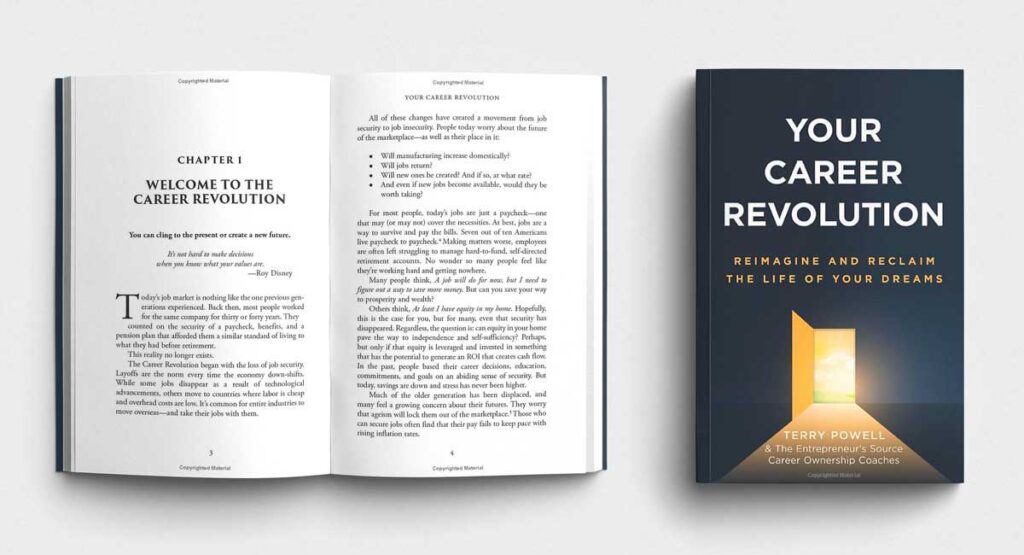
Read a sample on AMAZON
Dedication:
We dedicate this book to the tens of thousands of clients who have allowed us to guide then through their Journey of Discovery – courageous people who have made their dreams come true by taking the path less traveled. You inspire us every day. May you, the reader, also achieve your dreams and may this book empower you and assist you in your journey.
—The Entrepreneur’s Source Career Ownership Coaches
Watch Episodes on YouTube or Listen as a Podcast and more!












Share this post:
Related Posts
Your Trusted Resource for Career Ownership Coaching™ for helpful hints, best practices, anything related to career ownership.

The Unemployment Rate Isn’t Telling the Truth
You have heard the headlines. Unemployment is around 4%. Economists call it "full employment." The job market, we are told, is strong. So why does your job search drag on for months?

After the Layoff
It usually begins the same way. You get a calendar invite with no details. Your manager avoids eye contact on the video call. Then you hear the words that suddenly make your career part of your past.

Rest alone won’t solve burnout if your job is the real issue.
You finally took a break. Maybe it was a long vacation, take some time between jobs, or even a full career pause. You caught up on sleep, unplugged, and started to feel like yourself again. But once you returned to work, the exhaustion crept back in within just a few weeks.